
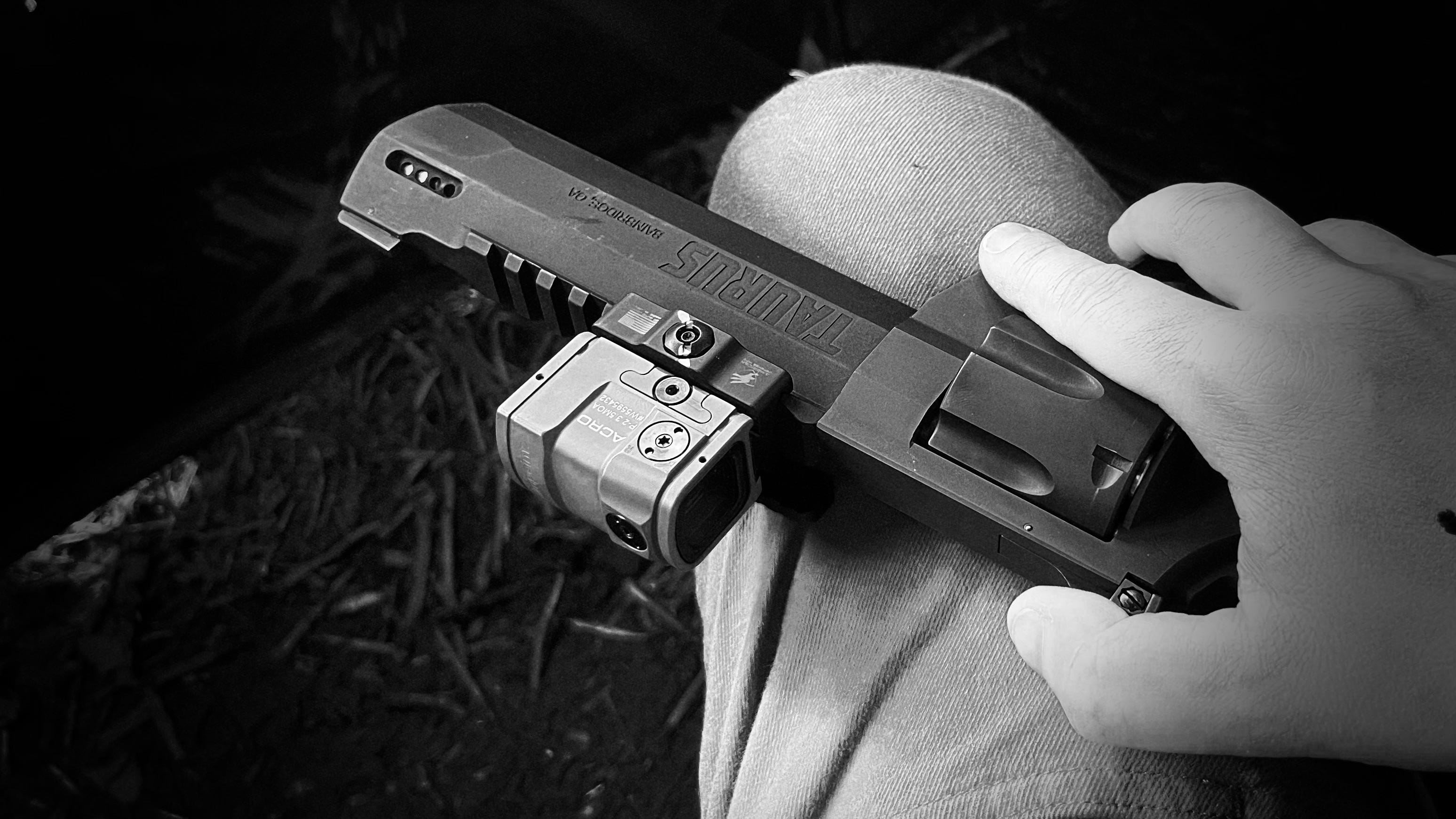
I can’t remember the last time I had a bad optic. Well, that’s not actually true. I remember back in the 2010s having lots of bad optics. I remember in a Modern Samurai Project class seeing a bunch of optics fail for various reasons. But lately? Not so much. In fact, the last time I thought I had a bad optic it was actually because I was using one of those batteries that has the child-safe bitterant coating, which can prevent the batteries contacts from working in a pistol optic. Swapped the battery and I was good to go.
It seems like we’ve reached a point as an industry where even the affordable optics are pretty damn good, and there are more of them than ever out there. At SHOT Show this year when I was walking around the basement on Friday, I saw almost as many optics companies as Turkish shotguns. So how did we get here?
The Television Effect
If you’re the sort of person who tracks the price of consumer goods, you’ve probably noticed that while lots of things are more expensive, one thing that is less expensive in terms of performance is televisions. You can get a 4K TV for $370 on Amazon right now that absolutely outperforms any TV from 10 years ago. That Amazon TV also objectively costs less than a top of the line TV from 20 years ago as well. TVs have gotten better and cheaper for a number of reasons, but the two that we’ll focus on are globalization and competition.
Components like semiconductors, capacitors, and display panels are now sourced globally at lower costs due to advanced fabrication techniques, higher yields , and supply chain optimizations in regions like Southeast Asia. This has improved reliability with modern parts that fail less often and last longer; while affordability stems from massive production volumes and technological refinements, making high-quality TVs accessible at budget prices.
Additionally, there has been tons of competition in the market for televisions. When I was a kid in the 80s and 90s, we had exactly one TV in the house. It sat in the living room and was the focal point of Friday night movies, a central fixture for family social time. Now, in 2026 in my own house I have 4 TVs. One in the living room, one in the master bedroom, one outside on the screened in porch, and one for my kid (he’s spoiled, don’t judge me). I’m a pretty average consumer; according to a Marist poll in 2025 about 80% of Americans have 2 or more TVs in their house. What all this means is that the market for TVs is highly competitive, which drives companies to pack more features in and keep the sets cheap.
Can we talk about Red Dots now?
Yes, yes we can. Red dot sights (RDS) are subject to pretty much the exact same market forces as televisions, especially consumer grade electronic sights.

Very briefly, let’s talk about duty grade vs consumer grade RDS. This is my opinion so please don’t get in your feelings about this if I say something mean about your favorite optics company. In my opinion, there are three duty-grade optics companies when it comes to RDS: Trijicon, Aimpoint, and Steiner. If I am selecting an optic to put on a gun that I would legitimately carry into combat or as an LEO, it would be one of those, and if we’re being honest it would be an ACRO P2.
Everything else falls into the category of consumer grade, and that’s not a bad thing. It just means that I personally don’t feel like I’d want to bet my life on them, which is also why my home defense gun has an ACRO P2 on it. Within that category of consumer grade there are definitely different tiers of quality ranging from excellent all the way down to airsoft grade. But what’s interesting is that most of the optics in the consumer category are pretty damn good.
As mentioned, it’s because the RDS market is subject to the exact same globalization and competition forces as the TV market. You can call it the Holosun Revolution, because Holosun was a huge driver behind it.
The Holosun Revolution
It wasn’t until the late 2010s into the early 2020s that we really started to see things change, and a lot of that was driven by Holosun. In 2021, a Holosun 407C, their competitor to the Trijicon RMR, cost around $200-$250, and it worked. It survived riding on pistol slides, fit the same footprint as the RMR, and as I said already, it worked. At the same time as Holosun was crushing the retail market, other small manufacturers were taking advantage of the exact same forces that drove down the costs of TVs. Small electronic components such as LEDs for emitters, compact batteries, and microelectronics have become cheaper and more reliable through international manufacturing, particularly in China and Southeast Asia, where high-volume production reduces per-unit costs.
I can’t actually name all the small consumer optics manufacturers off the top of my head, because there’s a million of them. Swampfox, Gideon, Vortex (although Vortex isn’t really small these days), Cyelee, Viridian, C&H Precision and a million other manufacturers have all exploded in the US market. The demand for pistol RDS has increased tremendously, to the point where I believe that in the next few years we’ll start seeing pistols from the factory with no iron sights at all. But what’s important is that the quality of most of these imported optics is all pretty good. If you’re not buying an optic that’s rated for jumping out of a helicopter with a knife in your teeth, then it kind of doesn’t matter which one of the consumer grade optics you get, because they’re all pretty good and they all do sort of the same thing.
Buying Advice
All that being said, I don’t think I’d go below $100 for an optic. Years ago I would have said $200, but I just checked MidwayUSA and there are all pretty good consumer grade optics for under $200, so never mind. That’s insane to me that you can get a red dot sight for under 200 bucks that in terms of performance crushes an RMR from 15 years ago. Is a modern RMR better? Definitely. But again, let’s be realistic about what we’re doing with these guns. The vast majority of people who get a gun for personal protection, CCW, or home defense don’t need an RDS that you can run over with an MRAP. They need that is on when they need it, and presents a clear dot.
So there’s the buying advice. Stay above $100 bucks, and get the dot from the company that you like most. Had a good customer experience with C&H Precision? Buy from them. You like the vibes from Swampfox? Get one of theirs. It really is the golden age of small red dot sights, and that means it’s a great time to buy.